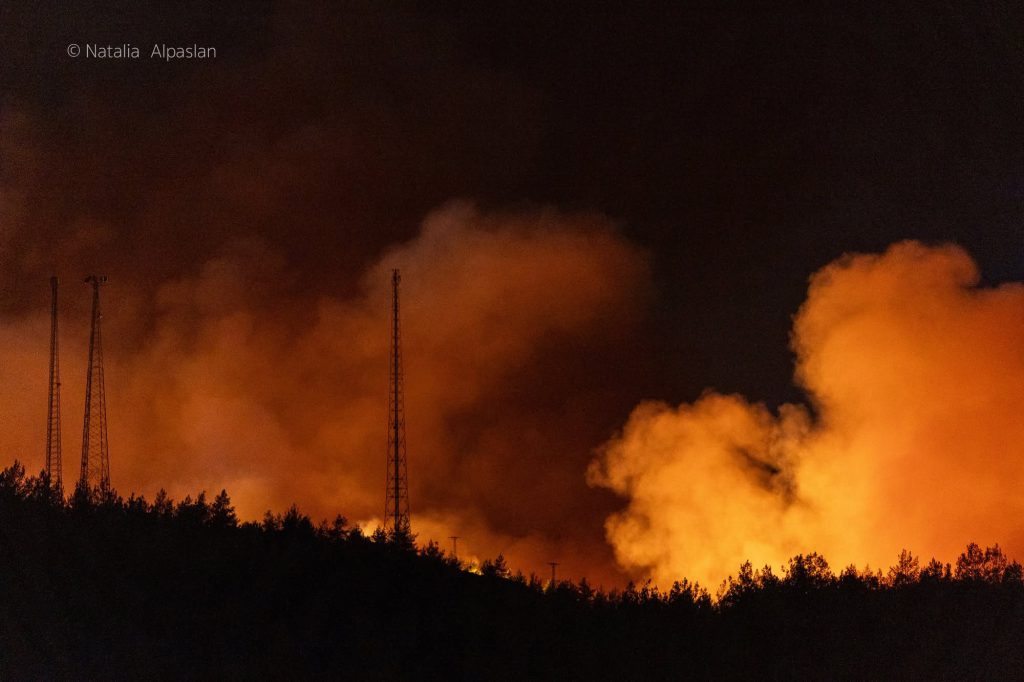
At the start of the summer, Turkey warned that the 2026 fire season could become one of the most challenging in recent years as rising temperatures, prolonged dry conditions and stronger winds increased the risk of forest fires across the country.
Those warnings have since been reinforced by a series of significant wildfires during the summer months, with authorities battling blazes in several regions as extreme weather conditions created dangerous fire conditions.
The latest firefighting efforts have focused on the provinces of Çanakkale, Balıkesir, Bursa, İzmir, Manisa, Aydın, Muğla, Antalya, Mersin and Adana, where high temperatures and strong winds have continued to create dangerous conditions. Officials have warned that the risk of fires reigniting remains high even after the main fronts are brought under control.
According to official figures, 206 fires have been recorded since Wednesday, when strong winds began driving flames across several parts of the country. Of these, 133 occurred outside forest areas, including agricultural land, scrubland and other open terrain.
As temperatures repeatedly climbed above seasonal averages, authorities said the combination of intense heat, very low humidity and strong winds allowed some fires to spread rapidly and made containment efforts significantly more difficult.
Turkey increases firefighting resources
In response to the growing threat, the Ministry of Agriculture and Forestry and the General Directorate of Forestry (OGM) expanded both air and ground firefighting capacity before the peak risk period arrived. Turkey is operating with 28 firefighting planes, 119 helicopters and 14 unmanned aerial vehicles, with a combined water-dropping capacity of 462 tons.
Additional water tenders, first-response vehicles and heavy machinery have also been deployed to support operations on the ground.
To reduce turnaround times for helicopters, the number of fire pools and ponds available for water collection has reached 4,852, with more planned.


Technology used to predict danger zones
Turkey is also relying more heavily on technology to monitor wildfire risks. The Forest Fires Meteorological Early Warning System, developed with the Turkish State Meteorological Service, is being used alongside artificial intelligence-supported risk maps.
The system analyses temperature, wind, humidity, terrain, vegetation and drought conditions together, allowing authorities to identify areas facing high fire risk up to seven days in advance and increase preventive measures.
Human activity remains the main concern
Despite increased firefighting capacity, authorities say human activity remains the biggest cause of forest fires. According to official data, 91% of forest fires are linked to human actions, including discarded cigarette butts, outdoor fires, burning agricultural stubble and other unsafe practices.

Turkey has strict penalties for offences that damage forests.
Anyone found responsible for causing a forest fire through negligence can face between three and 10 years in prison. Deliberately setting fire to a forest carries a minimum sentence of 10 years in prison, together with judicial fines ranging from 1,000 to 10,000 days.
If a forest fire is deliberately started as part of an organised group activity, penalties can increase to life imprisonment and judicial fines of between 20,000 and 25,000 days.
Public warnings have therefore been intensified throughout the summer. Authorities are urging citizens not to light fires outside designated recreation areas, not to burn agricultural stubble after harvest, and not to discard cigarette butts, waste or other flammable materials near forests or roadsides.
With temperatures continuing to remain above seasonal averages and strong winds affecting many parts of the country, officials say the fire risk remains high and are asking anyone who sees smoke or fire to report it immediately by calling Turkey’s emergency number, 112.
Curated from various sources
Photos By Natalia Alpaslan